


 Hot News
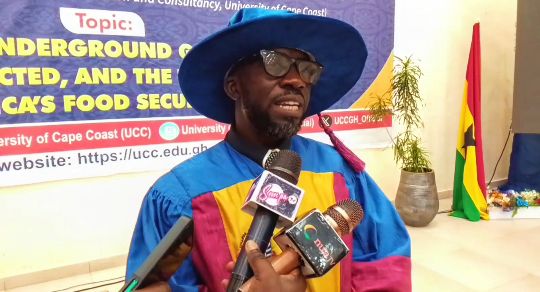
UCC Professor Urges Policymakers to Base Agric Interventions on Research-Proven, Data-Driven Manifestations to Ensure Sustainable Food Security
 Nov 06 2026
 8
Professor of Crop Ecophysiology and Improvement at the University of Cape Coast (UCC), Prof. Michael Osei Adu, has urged policymakers and stakeholders in Ghana's agricultural sector to base their agric interventions on research-proven evidence and data-driven strategies to aid in fostering sustainable food security.
He cautioned against implementing agricultural policies and programmes based primarily on assumptions, political considerations or conventional approaches without adequate scientific research and reliable data to establish their relevance, effectiveness and long-term sustainability.
Professor Osei Adu made the remarks at his inaugural lecture themed "The Underground Gospel: Roots, the Neglected and the Tuberous Route to Africa's Food Security."
According to the Crop Scientist, evidence-based policymaking remains critical to addressing the numerous challenges confronting Ghana's agricultural sector, including declining productivity, climate change, unpredictable weather patterns, post-harvest losses, rising production costs and the growing demand for food.
The Professor stressed that agricultural interventions must be informed by credible research findings, field assessments and measurable data to ensure that resources allocated to the sector produce meaningful outcomes for farmers and the broader economy.
He noted that understanding the specific needs of farmers, the prevailing conditions of agricultural production and the challenges within different farming communities is essential to developing interventions capable of delivering sustainable results.
He further emphasised that research institutions, particularly universities, have an important role to play in generating the scientific knowledge and innovative solutions required to strengthen agricultural production and improve food systems.
The Professor therefore called for stronger collaboration between policymakers, researchers, agricultural extension officers, farmers and private-sector actors to bridge the gap between academic research and practical agricultural development.
Such collaboration, he explained, would enable research findings to inform policy decisions while ensuring that innovations developed by researchers are translated into practical solutions that address the everyday challenges of farmers.
The call comes amid growing concerns over food security, climate-related threats to agricultural production and the need for Ghana to strengthen its capacity to produce sufficient, affordable and nutritious food for its population.
Prof. Denis Worlanyo Aheto, Vice-Chancellor of the University of Cape Coast who Chaired the occasion in address underscored that by integrating root science, neglected crop diversity, the root and tuber improvements, the underground gospel proposes a unified framework to advancing agricultural resilience, sustainable food production and food security in sub-Saharan Africa.
He further maintained that the lecture is not only to inform the wider community but to also uncover the hidden biological potentials in value neglected crops and the direct scientific incursion that sustains the African community.
Sompaonline.com// Eric Annan
Leave a Reply
Cancel Reply
Popular News


VOTE FOR CHAMPION

Who Wins NPP National Chairman


Recent News
Gallery




Recent Comment
-

I want you to help me get money, I want to pay my bills in school Thank you

-
Dr. Bawumia is ashamed of himself that is he making those unguided comments
-
Is this real? Because someone of us are novices we don't much about the operations tenet. Good morning