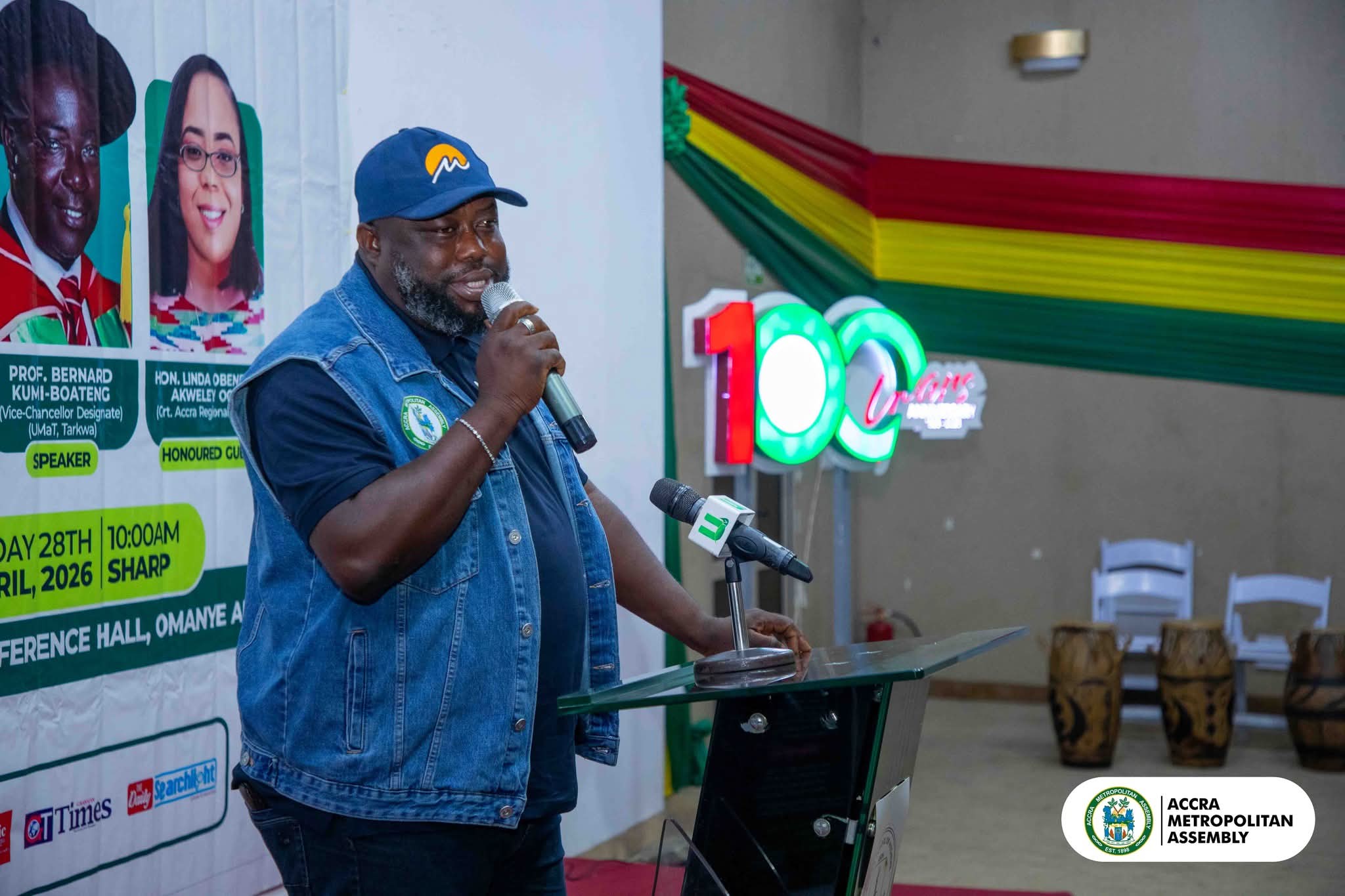

The Mayor of Accra, Hon. Michael Kpakpo Allotey has urged Environmental Health Officers to lead efforts in shaping public attitudes towards cleanliness, disease prevention and community hygiene, as part of measures to make the National Sanitation Day (NSD) exercise a permanent lifestyle among citizens.
According to him, the President’s vision for the NSD exercise was to encourage citizens to take ownership of cleanliness and make sanitation a regular habit rather than a one-off event.

The Mayor made the call when he attended the Accra School of Hygiene’s first centenary public lecture, held as part of activities to mark its 100th anniversary on the theme: “A Century of Hygiene Education: Reviewing the Impact of Accra School of Hygiene on Environmental Health and Sanitation in Ghana.”
He explained that just as people felt uncomfortable when they woke up and failed to sweep their immediate environment, they should develop the same attitude towards the NSD exercise and feel concerned when they failed to participate.
The Mayor also called on the Accra School of Hygiene to support the Assembly’s sanitation agenda by helping to intensify education, public sensitisation and community mobilisation on environmental cleanliness.

He urged the school, its management, lecturers, students and alumni to come together and use their professional knowledge to help build a clean, healthy and resilient city.
He said Accra could only achieve meaningful improvement in sanitation if professionals, institutions, communities and individuals worked together towards a common goal.
He pointed out that the Accra School of Hygiene had, over the past century, trained many professionals who had served the country in various capacities, especially in the areas of environmental health, sanitation enforcement and disease prevention, adding that attaining 100 years as an institution was not an easy achievement.
The Mayor said the school’s contribution to public health and sanitation in Ghana must be recognised, particularly because its products continued to work in communities to control and prevent diseases.
He further commended the institution for its resilience and long-standing service to the country, noting that its role remained relevant in the current drive to build a cleaner and healthier Accra.
Guest Speaker Professor Bernard Kumi-Boateng, Vice-Chancellor Designate of the University of Mines and Technology (UMaT), Tarkwa, said Ghana’s century of hygiene education had produced dedicated environmental health professionals, but the country’s sanitation challenges persisted because officers had not been given the numbers, resources and enforcement systems needed to succeed.

He said Ghana needed a stronger, digital and corruption-resistant local enforcement system, with trained enforcement teams, standardised fines, handheld devices, cashless payments, random integrity checks and public dashboards to track offences and payments.
The Head of Health Training Institutions in Ghana, Mr Anthony Goodman, in a remark, said measures were put in place to post trainees to work with institutions such as local government authorities, municipal assemblies, and other relevant agencies to support service delivery at the local level.
Touching on their allowances, Mr Goodman said the government had begun paying allowances owed to trainee nurses and other health trainees, adding that efforts were underway to clear outstanding allowances from January to April adding that, for the first time, bank accounts were being opened for the students to enable government to pay the allowances directly through Ghana Commercial Bank.
Sompaonline.com/Bismarck Oppong